Indragiri Hilir is one of the areas in Riau province that has a wide coastal landscape with abundant mangrove ecosystems. This regency is even often dubbed the” Land of a thousand trenches’, because its territory is filled with a network of natural and artificial trenches and canals that connect rivers, swamps, to the sea.
Mangrove forests in Indragiri Hilir stretch along the eastern coastline of about 131,658 hectares.
It is from these rivers that fishermen expect a livelihood to meet the food and economic needs of the family. The abundance of catches invites fishermen from other regions to catch here. Because of the increasing competition many fishermen who use poison hope abundant results.
The condition of mangrove forests in Indragiri Hilir regency has experienced significant damage and degradation due to various human activities, such as illegal flights, the use of toxins and land conversion whereas mangrove forests are like two sides of a coin that provide benefits to the community but on the other hand have threats. The abrasion came slowly-the ground was eroded, some houses on the waterfront had to move because the land was becoming depleted. The once clear river turned cloudy, and even the catch of fishermen was drastically reduced.
Seeing this condition, the community realized that if the forest continues to be damaged, their village will lose its “natural shield” as well as a source of life. So the idea was born to form an institution specialized in managing and maintaining village forests. From the joint deliberation, it was agreed on the establishment of LPHD (village forest management institution) and POKMASWAS (Supervisory community group).
LPHD was formed not only to stop the destruction, but also to restore the function of the forest. They began organizing protected zones and utilization zones, conducting regular patrols to prevent illegal logging, replanting mangrove seedlings, and inviting residents to use natural resources more wisely.
Keeping the river : present for the future
That morning, the chirping of birds accompanied the cool air when several boats began to approach and gather at the dock of a small post surrounded by lush mangrove forests.
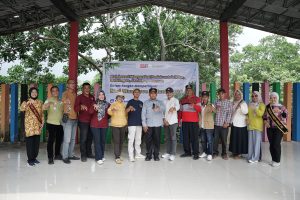
Every month there is a routine agenda that is carried out: a joint patrol between Lphd (Village Forest Management Agency) and Pokmaswas (Supervisory community group) from villages in Kuala Indragiri Sub-District, Indragiri Hilir.
Simple engine boats are filled with equipment-life vests, binoculars, field notes, cameras to prepare for using the Avenza Maps and KoboCollect applications. The atmosphere was warm, not only because the sun began to rise, but also because of the spirit of togetherness.
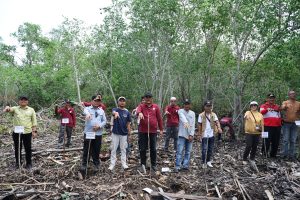
They traced the river channel flanked by mangrove forests. From a distance, the thickets of mangrove roots look like a solid natural fence holding back the waves. Between the trees, many birds fly, crabs hide in the mud, and occasionally fish jump as if to say hello. For the patrol members, the sight was not only beautiful, but also a reminder of how precious the mangrove ecosystem is.


Guarding Process
On the way, they met two fishermen. Patrol members check the use of bait, fishing gear, catch and use of transport. ‘don’t use poison, stun and dangerous fishing gear, sir, ” said one of the members kindly.
During the patrol, they check several vulnerable points: making sure there are no fishing activities using dangerous tools and hazardous materials, illegal logging activities, or garbage that is washed away by the current and activities that can damage the area. Sometimes, they also find fishing nets that are installed carelessly, immediately reminded and recorded as part of the report.
‘catching fish by using poison the results are indeed many compared to catches that do not use poison, but we then realized, afterwards it took at least 3 months to be able to recover in order to catch at the location, and we looked for the fish further away. The main thing that makes us stop is if we poison it means poisoning our family” Arbani, a member of Lphd Kelurahan Sapat.
Protecting the forest is not only a matter of prohibition, but also a matter of giving understanding. Patrol is also an opportunity to talk with fishermen or residents encountered in the field, because sometimes the fishermen encountered come from outside the region.
They provide an understanding of why forests need to be maintained, the use of fishing gear that does not damage the environment. All findings are then written in a report, which will be used for evaluation and follow-up with the village or related parties.
By noon, their boat returned to the pier. The field notes were already full of observations of the day. Although tired, their faces look satisfied. There is a sense of pride that they are not just patrolling, but also caring for an important legacy for the next generation. For them, every trip in the mangrove forest is a story of cooperation, care, and hope.
Environmental damage that used to be a threat is now a strong reason for the birth of a new spirit. LPHD and Pokmaswas present as evidence that from problems can be born solutions, and from damage can grow hope.

Sustainable
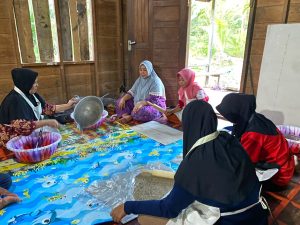
Despite not patrolling, the duty of the Forest Guard group did not stop. Some prepare reports on patrol results, develop forest management plans, some prepare plans for planting new mangrove seedlings. Sometimes, they sit down with residents to design eco-friendly economic activities; such as mangrove forest ecotourism and processed products from non-timber forest products. All of this is evidence that managing forests not only protects, but also provides real benefits to the village.
For lphd and Pokmaswas groups mangrove forest is the ‘heart of the village’. When they patrol, they become guards. When they are not on patrol, they become managers, educators, as well as future planners. All done in the same spirit: keeping the natural heritage alive, green, and blessing the next generation.
This program was initiated with the support of Blue Ventures from ICF (Initiative Climate Fund) funding by UK International Development and CCI (Climate Collective Initiative) by UBS in 2021 – 2025 in six villages which then increased to 12 target villages supported by OCEAN (Ocean Community Empowerment and Nature Programme), funded by UK International Development in 2024-2027.
This funding is expected to bring numerous benefits to these monthly patrols. This routine ensures that mangrove areas remain protected from threats. Local communities feel safer, knowing that their “natural shield” is protected. Furthermore, the patrols serve as a platform for mutual learning: LPHD members can share technical knowledge about social forestry, while Pokmaswas emphasizes the importance of disciplined monitoring.