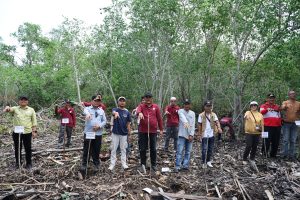
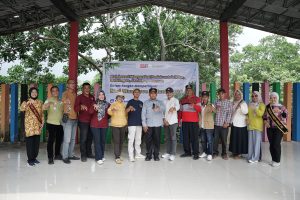
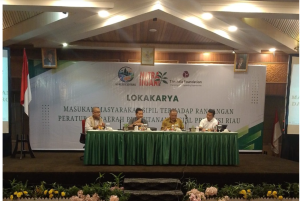
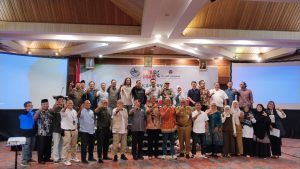
PEKANBARU (CAKAPLAH) – in order to increase the capacity of women in taking strategic roles as leaders, decision makers, and environmental protectors in the social forestry area, Yayasan Mitra Insani collaborates with Fitra of Riau province to collaborate with women groups in sharing information about Social Forestry (PS) and the implementation of Gender equality, disability, and Social Inclusion (GEDSI).
The two-day training presented participants from six districts in Riau province, namely Indragiri Hulu, Indragiri Hilir, Bengkalis, Kampar, Siak, and Pelalawan, with a total of 25 participants.
The participants came from women’s representatives in the Social Forestry Business Group (KUPS), The Village Forest Management Agency (Lphd), and the farmer women’s Group (KWT).
This training presented speakers from the Center for Social Forestry and Environmental Partnership (BPSKL) Kampar Syofia Rahmayanti. He explained about the 5 social forestry schemes, the stages of the process of proposing social forestry with the village forest (HD) scheme, the obligations and rights of the community and the prohibitions on Village Forest Management.
‘When village forest management is carried out for 35 years, each social forestry group must have a RKPS (social forestry work plan) in carrying out every social forestry activity,’ said Syofia Rahmayanti while explaining that RKPS must be owned by social forestry groups approved by BPSKL.
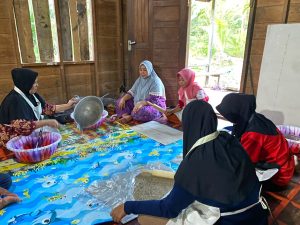
Syofia continued the involvement of women not only to increase community participation, but also to open creative economic opportunities.
‘We can improve the economy by creating a creative economy such as beekeeping, GOGO rice, coffee, pineapple and planting food crops that are allowed in forestry areas. One of the plants that are not allowed is palm,’ he said
In addition to knowledge of Social Forestry. One of the sessions that attracted the most attention was learning about Gender equality, disability, and Social Inclusion (GEDSI). The implementation of Gedsi is not only about the involvement of women but also the involvement of disability groups, and the involvement of the wider community.
Not only providing theory, this gedsi training also emphasizes on real practice. The participants were invited to see the biggest challenges, gender and sex differences, the duties and responsibilities of women and the role of women in participating in social forestry activities.
Siti Masfiroh as the speaker explained that participation is not only from men but we as a group of women can also be leaders ‘for example like KUPS Assyifa which is chaired by women and all its members are women,’ she said.
Nurisa, one of the participants from Siak regency, who is the chairman of Walet Hijau agroforestry, said that our group members are currently more women, and the results of agroforestry can help the family economy.
Gedsi training is expected to be the first step towards attitude change. It is hoped that more women will be able to become agents of change and encourage the creation of a more inclusive, fair and equal society for all.