My name is Andi Masrapi.
Since childhood, we have lived side by side with coconut groves, rivers, and mangrove forests. We never really imagined that one day we would become fishermen and make it our main source of income. At that time, our livelihood depended on coconut plantations. Only a small number of people were fishermen, and even then, they usually did so in between await the coconut harvest season, which came every three months. Furthermore, the prices of crabs, shrimp, and fish were still very cheap. I know this well, because at the time, my brother, H. Mustang, was a collector.
Over the past twenty years, the coconut plantations in our area have slowly begun to deteriorate. Initially, the earthen embankments that had protected the plantations from the water began to deteriorate and collapse. The local community, who were the first to realize the damage, chose to sell their coconut plantations gradually.
At the time, I thought the prices were still cheap, so I slowly bought damaged coconut plantations, hoping to save for the future. However, the damage has only worsened. Those who didn’t have time to sell their plantations could only watch their coconut plantations sink further and further, including myself (Andi Masrapi laughed wryly.)


Especially at the end of the year, the tides became very high and the rains were very heavy. The embankments were increasingly damaged, and saltwater literally poured into the gardens. We even thought it was the work of supernatural beings, because how could the earthen embankments we had just built be completely eroded by water overnight?
At that time, we could do nothing but watch our coconut groves slowly turn into dead trunks. The leaves and fruit fell one by one until only the trunks remained. We wondered why there was no assistance from the village or sub-district government. We only understood later when we received an explanation from Mr. Ahmad Riadi, who explained that Sapat Village did not have the same amount of funds as the village because we were a sub-district and did not receive village funds.

After nearly all the coconut groves here were destroyed, the only houses left were mine, my in-laws, and a few small huts belonging to fishermen who came seasonally for the crab catch. My brother also decided to move because the coconut groves were no longer productive, so I took over as a collector. However, at that time, the fisheries were also not doing well.
The catch of fish, shrimp, and crab was limited due to the rampant river poisoning. Ironically, this practice was not only carried out by people from outside the village, but also by people from the village itself. Their reasons varied. Some said, “People from other villages are free to poison in our area, why can’t we? Otherwise, where would we get our income?” When our river was poisoned by others, we couldn’t be angry, because we ourselves had done the same thing, even in other villages.”
Hope weaves hope
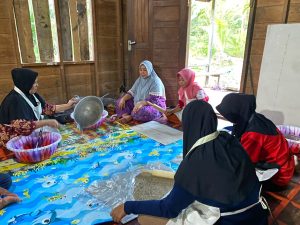
Change began to be felt when the Mitra Insani Foundation launched a forest and river management program in our area around 2016. Since then, river protection activities have become more frequent, although initially focused on Parit 18 Basira. It wasn’t until 2021 that our area in Parit 18 B began receiving visits and direct assistance. We carried out many activities together, one of which was collecting data on mangrove crabs. My wife, I, and several community members were directly involved as enumerators.

Image: crab data collection process by enumerator
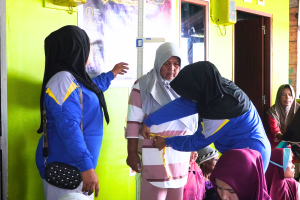
After data collection was complete, we shared the results with the community. Representatives from the district, province, and even overseas were present to witness the data feedback process. The results were quite disappointing. I personally noticed that most of the catch was small, mostly category C, weighing less than 2.4 ounces, and many even less than one ounce.
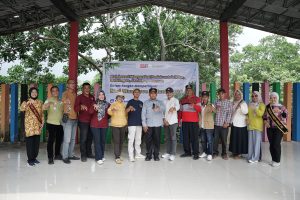
Based on the crab data collection, the Mitra Insani Foundation proposed the idea of replicating river protection practices in other areas, such as the “prohibited area” in Padang and Kampar. They explained that this model requires no significant capital, no cages, and only requires markers and mutual agreement.
Before the closure, we held a joint meeting after learning that the sub-district could not create Village Regulations. We defined the river basin and its boundaries, installed signs, determined the duration of the closure and opening times, and agreed on sanctions for violators.
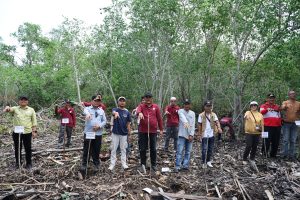
Ultimately, we agreed to propose an area that was once a coconut plantation, now submerged and overgrown with mangroves, as the closure area. The term used at the time was “Temporary Closure” which covers an area of approximately 22.3 hectares. The river is still navigable for transportation, but catching crabs, shrimp and fish is prohibited.

Image: Installation of a Fishing Prohibition Sign in the temporary closure area.
The most difficult agreement for us at the beginning was releasing small crabs weighing less than one person. In the past, any size would be taken, but this time it was different. We made this decision consciously, after understanding the data and discussing it together. We also agreed that each group member would release a certain number of baby crabs to the closure site.
The first closure began on September 22, 2022, and lasted four months. In the early days, many of us were still hesitant and worried. Some even secretly violated the agreement. But we kept reminding each other that what we were protecting was a shared asset, and the harvest should be enjoyed together.
December 26, 2022, was a moment I will never forget. In two days of opening, the catch reached 104 kilograms. Despite this, many small crabs were still caught, and we agreed to release them again. To this day, we continue to practice opening and closing areas.

New Hope for Coastal Livelihoods
This activity gave us new hope. We no longer saw the river as a place to catch as much as possible, but rather as a source of life that must be protected together. Fishermen reminded each other, collectors became more open, women became more involved in discussions, and the village government increasingly trusted the community’s capabilities.
For me personally, the biggest change is visible in the condition of our village today. The area is starting to become bustling again. People are starting to settle down and rely on the catch for a living. The concern from outside is also becoming more apparent, as more people come to visit, and we no longer feel lonely. We also realized that the closure not only impacted mangrove crabs, but also shrimp and fish. When crab catches began to decline, some fishermen switched to catching giant prawns, giant prawns, setting up traps, or using other fishing gear.
In addition to the Mitra Insani Foundation, various other parties began to come forward, providing support and assistance. As Bang Dodi Faudilah of the Mitra Insani Foundation often said, “If there is sugar, the ants will come by themselves.” Now I truly understand the meaning of that saying.
The Mitra Insani Foundation’s mentoring program began the support of Blue Ventures from ICF (Initiative Climate Fund) funding by UK International Development and CCI (Climate Collective Initiative) by UBS in 2021 – 2025 in six villages which then increased to 12 target villages supported by OCEAN (Ocean Community Empowerment and Nature Programme), funded by UK International Development in 2024-2027.

by : M. Rukim Program Officer Fisheries